

APPENDIX H – Check Valves
Main – Previous – NextSurge Analysis and the Wave Plan Method
Supplementary Material: Example Problems and Solutions
Appendix H – Problem 8
H.8 A 200 mm globe-type control valve with a wide-open resistance of 500 is used as a check valve on a pipeline. The globe valve stem position changes from its fully open position to a closed position linearly in 10 time-steps. each of ∆t, upon flow reversal. Assume that the flow-area ratio is linearly related to the stem position of the globe valve.
a. If the pressure differential across the valve (the difference between the downstream pressure head and the upstream pressure head) associated with the forces driving reverse flow through the check valve remain constant at 15m, what is the expected check valve slam pressure?
b. What is the expected check valve slam pressures if the check valve’s area ratio (and hence its stem position) changes nonlinearly as shown in the following figure?
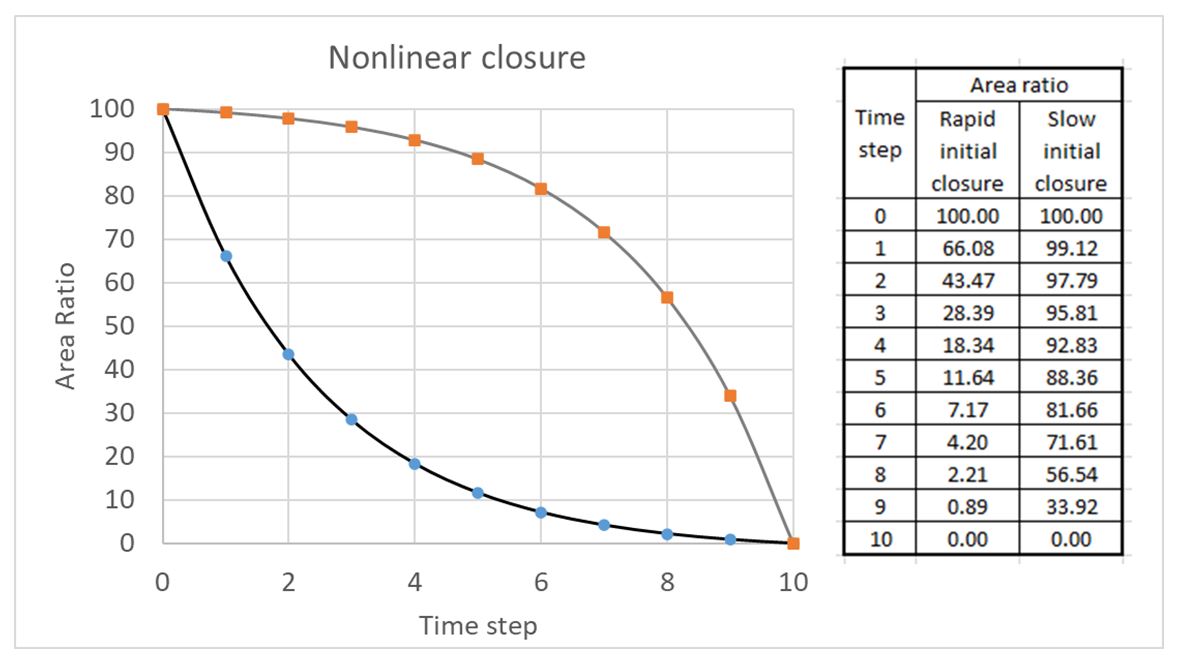
Solution:
- If the pressure differential across the valve (the difference between the downstream pressure head and the upstream pressure head) associated with the forces driving reverse flow through the check valve remain constant at 15m, what is the expected check valve slam pressure?
Globe valve wide-open resistance Kf = 500. Pressure differential across the valve ∆H = 15m. The associated flowrate when the valve is fully open = 0.1732 m3/s.
Valve closes linearly in 10 time steps, each time reducing the stem position by the same amount. As the flow area of the valve is linearly related to the stem position, the area ratio changes linearly in each time step.
The area ratio for any valve is related to its resistance ratio by an inverse square root relationship Ao/Af = √(Kf/Ko), where Kf is the resistance of the fully open valve with an area of Af, and Ko is the resistance of a partially closed valve of area Ao.
Area ratio during the last time interval prior to CV closure is Ao/Af = 0.1. The associated valve resistance during the last time interval Ko = Kf * (Af/Ao)2 = 50000. As the driving force remains the same, the flowrate during the last time interval prior to CV closure = 0.01732 m3/s. The velocity in a 200 mm pipe for a 0.01732 m3/s flowrate = 0.55 m/s.
If the pipeline diameter is 200 mm and made of mild steel, the approximate celerity would be 1000 m/s and hence the check valve slam pressure would be 56m. If the pipe material were PVC with a celerity of 300 m/s, the slam pressure would be 16.8m.
Summary of revisions to this page:
Date/Revision